

Tahajjud is a special voluntary prayer performed in the quiet hours of the night. Muslims wake up after sleeping to stand before Allah in deep devotion. It is one of the most beloved acts of worship in Islam.
This prayer brings a person closer to Allah in a powerful and personal way. The night is calm and free from distractions, making it the perfect time to pray and reflect. Many believers find peace, strength, and answered prayers through Tahajjud.
The Night Prayer of Devotion

- Tahajjud is a special night prayer that Muslims offer voluntarily after sleeping.
- It is prayed in the last part of the night before Fajr.
- This prayer shows deep love and devotion to Allah.
- Muslims who pray Tahajjud seek closeness to Allah in the quiet of the night.
- Allah loves those who rise from sleep just to worship Him.
How to Pray Tahajjud
- Wake up after sleeping and make a fresh wudu.
- Make your niyat in your heart for Tahajjud prayer.
- Pray in sets of two rakats at a time.
- Recite Surah Al-Fatiha and any other Surah in each rakat.
- Pray slowly with full focus and a humble heart.
- End your night prayer with Witr before Fajr begins.
Tahajjud Prayer Niyat
- Niyat means setting your intention in your heart before you pray.
- You do not need to say it out loud, but you can if it helps.
- Your niyat should be sincere and purely for the sake of Allah.
- Say in your heart: “I intend to pray two rakats of Tahajjud for Allah.”
- Always make sure your intention is clean and honest.
Tahajjud Prayer Dua
- After praying Tahajjud, raise your hands and make heartfelt dua.
- This is one of the best times when duas are accepted by Allah.
- Ask Allah for anything — forgiveness, health, guidance, or blessings.
- The Prophet ﷺ used to make long duas during Tahajjud.
- Recite this beautiful dua of the Prophet ﷺ:
- “Allahumma lakal hamd, anta qayyimus samawati wal ard…”
- (O Allah, all praise is for You, You are the Sustainer of the heavens and the earth.)
तहज्जुद की नमाज़ की दुआ
- तहज्जुद की नमाज़ के बाद अल्लाह से दिल से दुआ मांगें।
- यह वह वक्त है जब अल्लाह सबसे ज़्यादा दुआएं कबूल करता है।
- अपने गुनाहों की माफ़ी और हर ज़रूरत के लिए दुआ करें।
- नबी ﷺ ने यह दुआ तहज्जुद में पढ़ी:
- “अल्लाहुम्मा लकल हम्द, अन्त नूरुस समावाति वल अर्ज़…”
- (ऐ अल्लाह, सारी तारीफ़ें तेरे लिए हैं, तू आसमान और ज़मीन का नूर है।)
What is Tahajjud?
- Tahajjud is a voluntary night prayer prayed after waking from sleep.
- It is not obligatory, but it is highly recommended in Islam.
- The word “Tahajjud” means to give up sleep for the sake of worship.
- Allah mentions this prayer in the Quran in Surah Al-Isra.
- The Prophet ﷺ never missed Tahajjud throughout his life.
When to Pray Tahajjud?
- The best time for Tahajjud is the last third of the night before Fajr.
- This is when Allah descends to the lowest heaven and calls His servants.
- It is the most blessed time to make dua and worship Allah.
- You can also pray after midnight if the last third is difficult.
- The key is to wake up from sleep before praying.
- Even a short Tahajjud at any part of the night has great reward.
The Importance of Tahajjud Prayer
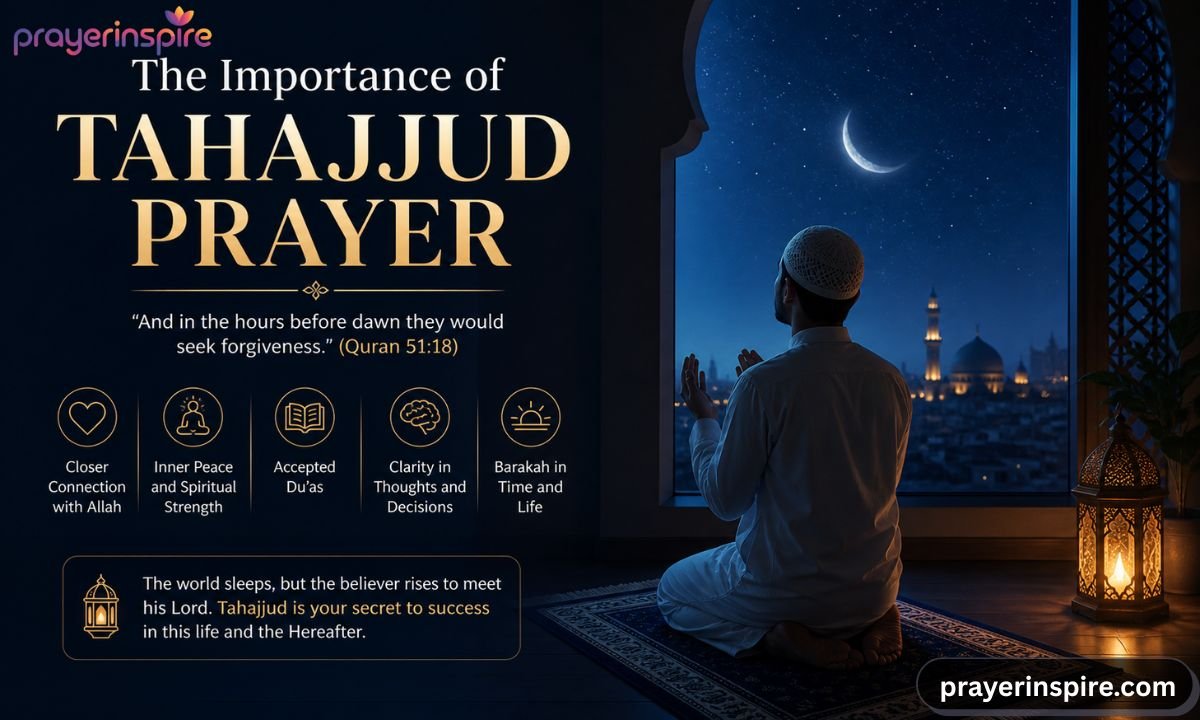
- Tahajjud is one of the greatest voluntary acts of worship in Islam.
- Allah praises those who pray at night in many verses of the Quran.
- It is a sign of a truly devoted and God-fearing believer.
- The Prophet ﷺ said Tahajjud is the best prayer after the five obligatory prayers.
- It purifies the heart, removes sins, and brings peace to the soul.
- Regular Tahajjud builds a very strong bond between you and Allah.
How Many Rakat in Tahajjud?
- There is no fixed number of rakats for Tahajjud.
- You can pray a minimum of 2 rakats and a maximum of 8 rakats or more.
- The Prophet ﷺ usually prayed 8 rakats of Tahajjud followed by 3 Witr.
- Pray according to your energy and available time.
- Even 2 rakats of Tahajjud are enough to earn great reward.
- Always end your night prayer with Witr before Fajr begins.
Also read this: 31 Tahajjud Prayer: The Night Prayer of Devotion
How to Perform Tahajjud Prayer?
- Wake up after sleeping and make fresh wudu.
- Make your niyat for Tahajjud prayer in your heart.
- Pray 2 rakats at a time, reciting Surah Al-Fatiha and any other Surah.
- Pray slowly and with full focus and humility.
- After finishing your rakats, sit and make heartfelt dua to Allah.
- End with 3 rakats of Witr prayer before Fajr begins.
- Try to recite longer Surahs if you can for greater reward.
Du’as for Tahajjud
- Raise your hands after Tahajjud and make sincere dua to Allah.
- Here are three beautiful and simple duas to recite:
Dua 1 — Dua of the Prophet ﷺ:
- “Allahumma lakal hamd. Anta nurus samawati wal ard.”
- (O Allah, all praise is Yours. You are the Light of the heavens and the earth.)
Dua 2 — For Forgiveness:
- “Astaghfirullaha rabbi min kulli zambiyon wa atoobu ilaih.”
- (I seek forgiveness from Allah for all my sins and I repent to Him.)
Dua 3 — For Guidance:
- “Rabbana atina fid dunya hasanatan wa fil akhirati hasanatan waqina azaban nar.”
- (Our Lord, give us good in this world and good in the Hereafter, and protect us from the Fire.)
What is the Difference Between Tahajjud Prayer and Qiyamullail?
- Qiyamullail means any voluntary prayer prayed at night, even before sleeping.
- Tahajjud specifically means the prayer prayed after waking up from sleep.
- All Tahajjud is Qiyamullail, but not all Qiyamullail is Tahajjud.
- Tahajjud has more reward because it requires extra effort to wake from sleep.
- Both are great acts of worship and bring immense blessings from Allah.
Can Tahajjud Be Prayed Before Fajr?
- Yes, Tahajjud must always be prayed before Fajr time begins.
- Once the Fajr time enters, the time for Tahajjud is over.
- Always check the Fajr time in your area and finish before it starts.
- The ideal time is the last third of the night, just before Fajr.
- If you wake up very close to Fajr, you can still pray 2 quick rakats.
- Never delay until after Fajr, as the time will have passed.
Frequently Asked Questions
What is Tahajjud Prayer?
Tahajjud is a voluntary night prayer that Muslims pray after waking up from sleep before Fajr.
Is Tahajjud Prayer obligatory in Islam?
No, Tahajjud is not obligatory. It is a highly recommended voluntary prayer with great reward.
How many rakats are in Tahajjud Prayer?
You can pray a minimum of 2 rakats and a maximum of 8 rakats, followed by 3 Witr.
What is the best time to pray Tahajjud?
The best time is the last third of the night, just before Fajr time begins.
Can I pray Tahajjud without sleeping first?
No, Tahajjud must be prayed after sleeping. Without sleeping first, it is called Qiyamullail, not Tahajjud.
What dua should I read after Tahajjud?
You can read “Allahumma lakal hamd” and ask Allah sincerely for forgiveness, guidance, and blessings.
Can women also pray Tahajjud Prayer?
Yes, women can absolutely pray Tahajjud. It is a beautiful act of worship open to every Muslim.
Conclusion
Tahajjud is one of the most beautiful and powerful acts of worship in Islam. It is a special time when you leave your sleep just to stand before Allah. This prayer shows how much you love and trust your Creator.
Make Tahajjud a part of your daily night routine, even if it is just 2 rakats. Allah is always waiting for His servants in the last third of the night. May Allah give us all the strength and love to wake up and pray Tahajjud regularly. Ameen.
